Yeah the driver supporting LEDs and exposing them should be installed. The exposed LEDs can be found in /sys/class/leds/<device>/multi_[index|intensity], See Linux kernel documentation for details: LED handling under Linux and Multicolor LED handling under Linux

Jure Repinc
Digital and software freedom/rights advocate from Slovenia, Europe. Also a member of the Pirate party. You can find me on Mastodon: @JRepin@mstdn.io
- 453 Posts
- 88 Comments
Joined 1 year ago
Cake day: June 8th, 2023
You are not logged in. If you use a Fediverse account that is able to follow users, you can follow this user.
 6·4 days ago
Depends on the specific distro and their upgrades policies.
Usually with normal distributions you get an update to a new major version (e.g. from Plasma 6.0 to Plasma 6.1, or some versions can be skipped) when a new version of the distribution gets released, and in the mean time you only get bug fix releases (e.g. 6.0.x to 6.0.y). Sometimes some distributions also make special backports available to bring new major versions to same distro version.
With rolling release distributions (e.g. openSUSE Tumbleweed) you get new major releases in a few days after they are released.
So you need to check with Nobara how they handle this.







 2·19 days ago
One way of greatly improving ROCm installation process would be to use the Open Build Service which allows to use the single spec file to produce packages for many supported GNU/Linux distributions and versions of them. I opened a feature request about this.
 571·19 days ago
One way of greatly improving ROCm installation process would be to use the Open Build Service which allows to use the single spec file to produce packages for many supported GNU/Linux distributions and versions of them. I opened a feature request about this.



Most of them are C++/Qt there is also a lot of QtQuick/QML code which can do a lot and is very similar to ECMAScript, so maybe that would be a great start for someone coming from webdev.




 51·3 months ago
That would be huge improvement. They could even make it look and act almost as restrictively as GNOME is since KDE Plasma is so flexible and configurable so it can easily mimic GNOME or any other desktop out there. And from there one they could slowly start unlocking the full power of KDE Plasma desktop.
My friend has one (if I remember it it a Slimbook or Tuxedo laptop) and as far as he told me it is flawless (well almost). My next laptop will for sure be a KDE CPU+GPU one. I hear good things about the combo and if it is any similar to desktop AMD GPU support I will be happy.
Please could you stop spreading Google lies and propaganda. Instead of this please focus more on good news from GNU/Linux and libre and opensource in general. I have seen way too much GAFAM/BigTech/corporate lies and propaganda being spread here lately.
 1·3 months ago
No wonder. all GAFAM is a spyware surveillance capitalism mafia and they work together. If you really want to THINK different you need to look into libre and opensource software like GNU/Linux and the likes.
They should ditch them for so many other reasons too. Also Public Money, Public Code. Al public institutions should only use libre and opensurce software. The only way to preserve privacy, freedom, and digital sovereignty.
Yeah, fines should be much much higher and yeah if you do not pay ban. And they should use the money from the fines to invest into developing libre and opensource software and hardware.
You can also watch it on official KDE Peertube server, also with fully respecting privacy https://tube.kockatoo.org/w/e6e8f177-22f1-432a-9c7f-ab76b17a5b54
 1·4 months ago
So not even with setting the Width option to Fill Width and Style with disabled Floating option? (see this picture for refeence)
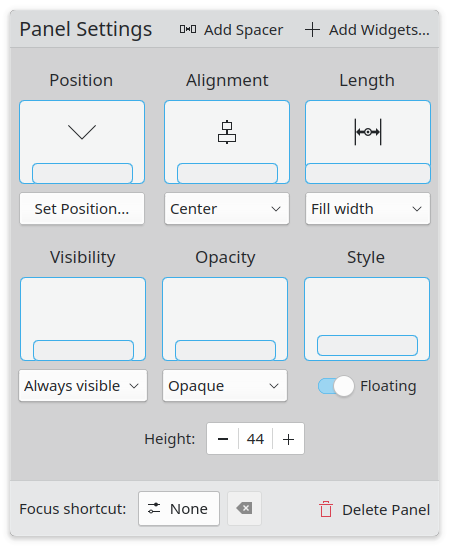
Yeah I hear good things about qemu. Will really have to reserve some time to learn it some day. And just for kicks I have just tried and installed KDE Neon into VirtualBox too, and damn I am actually surprised how fast Plasma runs under it, definitely faster than Plasma 5 did. Another job well done :)
Yeah also don’t like the dock, but with KDE Plasma at least you can make it full width as it is so nicely customizable. VM, oooo I wonder how it will run there, I guess it will be quite slow, at least Plasma 5 was a lot slower in VB for me than later on real hardware, so it might not be well representative.
 15·4 months ago
HP48GX scientific calculator, damn old, still works great still use it a lot
Steam Deck, handheld gaming computer, barely use PS5 anymore, this one is so quick and convenient to just pause and resume games and take gaming everywhere and the SteamOS Linux is awesome. I use the desktop mode with full KDE Plasma desktop as my portable computer a lot when on the go. Also with the dock station I can use it as a gaming console when going on holidays.
And the flat I live in. Good thing as I bought it quite a few years ago since the home prices are just criminal and highly unjust now. This stuff does not belong on markets to be sold for profits or some criminal short-time renting crap like AirBnB
Yeah it is way to often we forget how good we have it on GNU/Linux. I also had to work a lot with the two proprietary OSes a lot during the past year or so at work where our software is cross-platform so I had to test it everywhere. Oh and boy the closed proprietary options are even worse then I remember them from 5+ years ago. So dumbed down so much spyware. One is also very bloated and don’t get me started how hard it is to properly support them when programming and it is so hard to debug when something goes wrong. Just terrible experience for things I take for granted while using GNU/Linux every day.
So yeah thanks to all people developing libre and opensource software and GNU/Linux especially, just love it how it gives me the choice of which desktop to use, or if I do not want to use GUI desktop at all, thanks for keeping everything deep down event to the center of the kernel accessible, and just hidden behind a very nice GUI desktop, thanks for being so open it is much easier to see things when they go wrong and see where it went wrong and is so much easier to debug. Thanks for keeping and strengthening our 4 essential freedoms and for actually caring about our privacy instead of just bullshiting and talking like you care. And thank you for not adding more stupid corporate bloat into your OS and apps. You are the real unsung heroes of the digital world, unlike this GAFAM/BigTech exploitative mafia making their products ever more closed and shitty in general just to exploit you more.
FYI: an interesting video on How KDE Plasma 6 Was Made
The have 3 editions: User (stable, released packages), Testing (using stable version branches with updates, but not released/tested yet), Unstable (using development branches with new features, untested and not released yet)
Bash is my favourite one, second to it being Fish